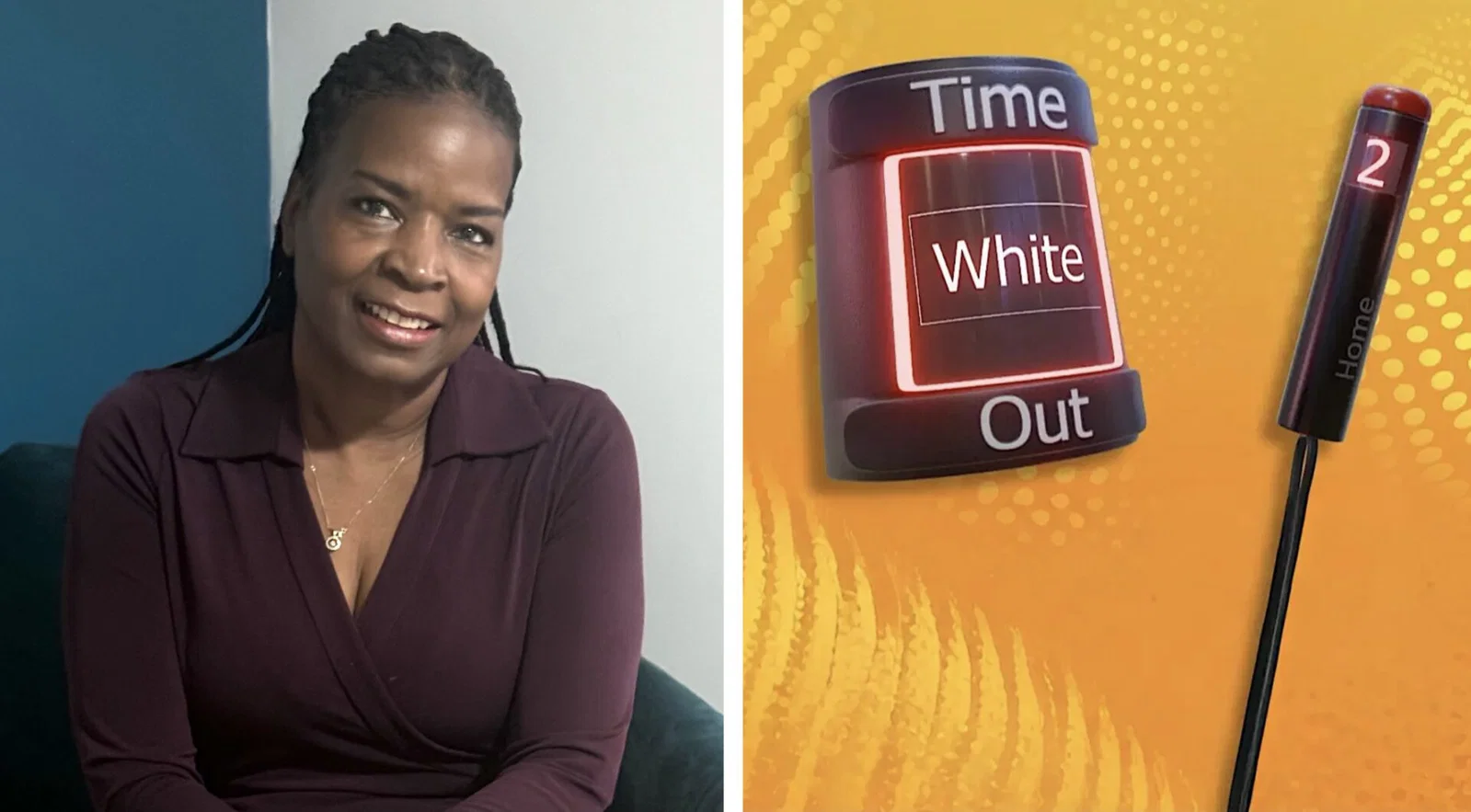
Black Woman Inventor Creates Device That Could Revolutionize Sports Timekeeping.
This invention could mark a significant advancement in sports officiating technology.
The Frustration That Sparked the Innovation
As a youth girls’ basketball coach in New Jersey, Maria Carthon recalls one recurring challenge: trying to get a referee’s attention when she needed to call a timeout. Too often, stoppages came late—or didn’t happen at all—creating frustration during crucial moments of the game.
As a passionate sports fan, Carthon noticed that coaches at various levels faced the same challenge. She found it surprising that, despite today’s advanced technology—including instant replay systems designed to reduce human error in college and professional sports—there was still no reliable way to ensure that valuable time was preserved, particularly during the most critical moments of a game.
After a particularly frustrating experience in 2011, when a referee brushed aside her complaint about not being granted a timeout and told her, “Next time, jump up and down and yell,” Carthon decided it was time to address the problem herself.
“Sports have invested billions of dollars in technology to determine whether a player’s foot touched the out-of-bounds line or the three-point line,” Carthon explained. “Time is critical during the most strategic moments of a game, and it shouldn’t depend on whether a coach can be heard over the crowd. If no one else was going to solve the problem, I decided I would.”
From Idea to Product: Building the Business Strategy
While serving as Associate Director of Programs in the Office of Enrollment Management at Emory University School of Medicine in Atlanta, Carthon began researching inventions and expanding her knowledge of product development, intellectual property, and business strategy. She later returned to college to earn a Master’s degree in Business Law, giving her the expertise to transform innovative ideas into viable business opportunities.
Introducing T.O.S.S.: How the Wireless Timeout System Works
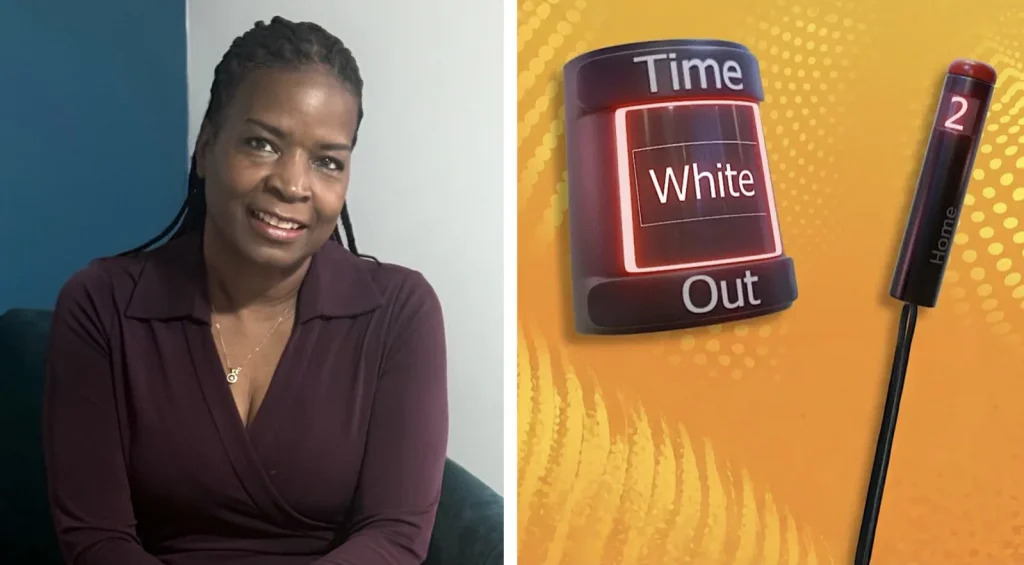
Her dedication eventually led to the development of the Time Out Synchronized System (T.O.S.S.), a wireless device designed to help coaches communicate with referees instantly when they need a stoppage in play. With the push of a button, the system alerts an official from a distance, even in noisy, crowded game environments, making it easier for coaches to signal their request for a timeout.
This invention could represent a significant advancement in sports officiating technology, designed to help address game-management challenges that may influence the course of a competition.
Developed in 2023 and continuing to evolve, the system operates through a simple two-step process. When a coach needs a timeout, they press a compact handheld device, which immediately sends a wireless signal to a wrist-worn device used by the referees. The vibration alerts officials to the timeout request, regardless of their location on the court or playing field.
Carthon and others who have tested the innovation believe that T.O.S.S. has the potential to become a standard feature at sporting events in the future.
Endorsements from Professional Athletes and Industry Experts
Former NFL player Ryan McNeil, who tested T.O.S.S., highlighted the challenges of introducing change in the sports industry. “Sports has been an industry where change is hard,” McNeil said. He noted that the conventional mindset has often been, “If it’s not broke, don’t fix it.” However, he believes Carthon’s product addresses both efficiency and strategy by reducing the delays and uncertainty coaches can face when trying to call a timeout. In his view, T.O.S.S. can help minimize the chaos surrounding these critical moments and provide a more reliable way for coaches to communicate with officials.
Others who have encountered the innovation, including former NBA player Willie Anderson, share a similarly positive view. Anderson, who played for four teams over a nine-year professional basketball career, tested T.O.S.S. and described it as “a game-changer.” He explained that the device could benefit both referees and coaches, particularly during the closing moments of a game when crowd noise can make communication difficult. Because referees would receive a vibration when the timeout button is pressed, they could remain focused on the action rather than constantly watching the sidelines. Anderson believes this could significantly reduce the pressure placed on officials.
Anderson also recalled coaching an AAU game several years ago when he urgently needed to call a timeout but struggled to get the referees’ attention. “It was wild and crazy in the stands, and the other team had the ball, and they missed the shot,” he recalled. “I was trying to call a timeout, but the ref was focused on all the activity on the floor. By the time I got the timeout, we had lost about six seconds on the clock.”
According to Anderson, those six seconds could have made a meaningful difference, potentially giving his team an opportunity to win. Instead, there was not enough time to organize a play. He believes a system like T.O.S.S. could have prevented the delay, illustrating the potential value of the technology in high-pressure game situations.
Grassroots Deployment and Real-World League Testing
Despite receiving numerous endorsements supporting T.O.S.S., Carthon has found it difficult to gain access to officials within high-level sports organizations who are responsible for evaluating and approving new technologies for league-wide adoption. About six months ago, she decided to take a different approach.
“We shifted and adopted a bottom-up approach, focusing first on recreational leagues and high school athletics,” Carthon said. “What is especially exciting is that this next phase is no longer just about developing the technology; we have real-world testing.”
The strategy has already yielded promising results. T.O.S.S. was recently piloted successfully in Henry and DeKalb counties in the Atlanta metropolitan area, as well as in Georgia Parks and Recreation basketball leagues.
“Several leagues have expressed interest in piloting T.O.S.S.,” Carthon said.
Capital Investment and Venture Mentorship
With financial support from her fiancé, Cliff Ochemba, and her brother, Carthon has invested approximately $100,000 in developing her invention. She estimates that an additional $200,000 to $250,000 will be needed “to take the technology to the next level and develop a more robust, league-ready product.” The additional funding would go toward engineering and product design, developing the next-generation prototype, conducting further testing, and producing a limited pre-production run.
To help move T.O.S.S. toward that stage, Carthon sought mentorship through the American Technology Venture Lab (ATVL). Working under the guidance of Dennis C. Hayes, inventor of the Hayes PC modem, she further developed the business strategy behind T.O.S.S. and gained valuable knowledge in intellectual property commercialization, entrepreneurship, technology ventures, and scaling an innovation from an initial concept into a market-ready product.
Looking to the Future of Sports Technology
Anderson expressed confidence in the technology’s potential, saying, “That technology will make it.” However, he also cautioned Carthon to protect her invention as interest from major professional leagues grows, noting that the NBA could potentially seek to acquire or develop access to the technology.
As a mother of two adult children, Carthon appears more focused on continuing to refine the innovation. With the product already patented, her priority is strengthening T.O.S.S. and addressing any concerns leagues may raise about its functionality and reliability.
“It’s exciting. We have made great strides,” Carthon said. “But there are more strides to be made.”